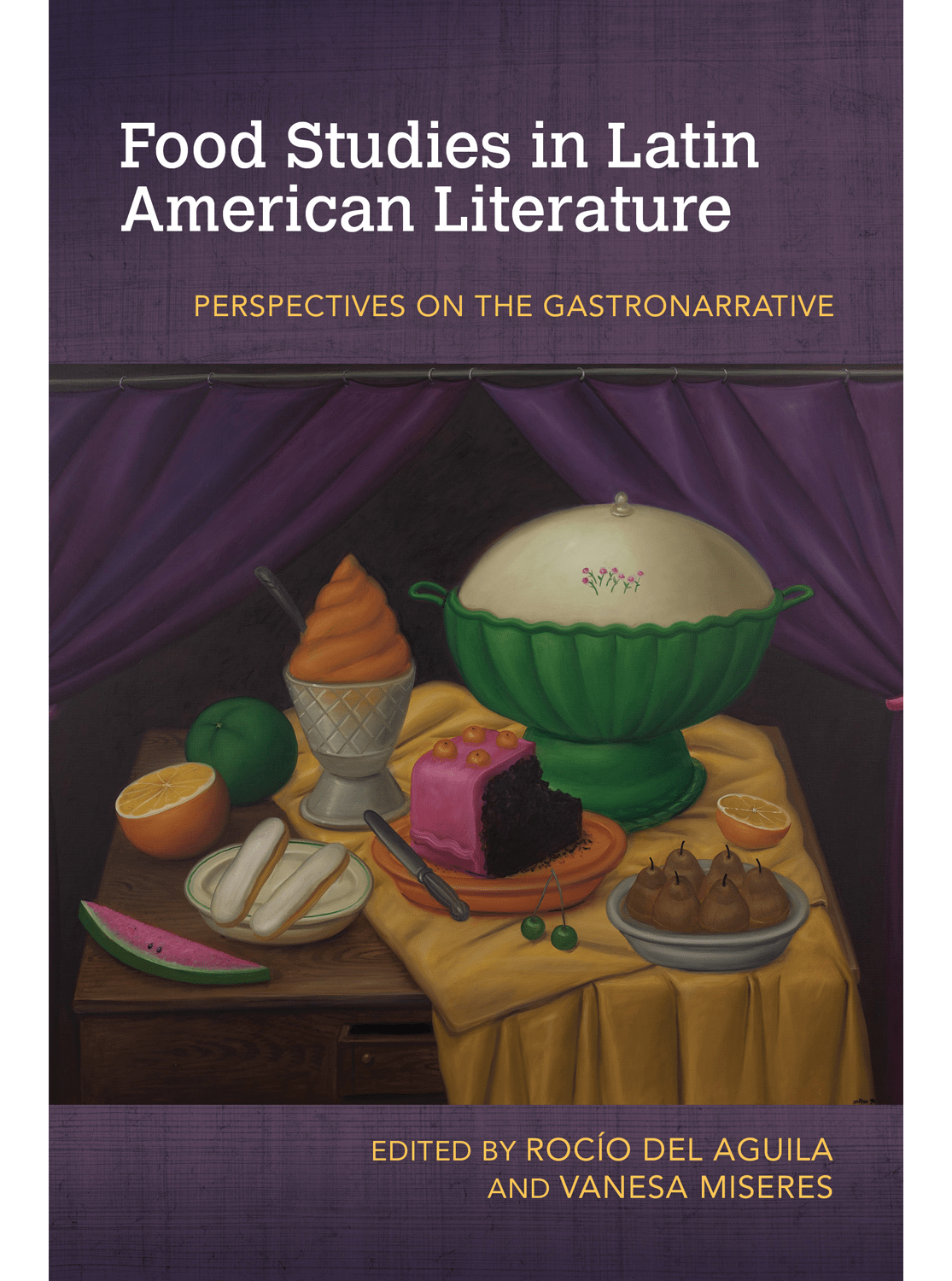
About Food Studies in Latin American Literature presents a timely collection of essays analyzing a wide array of Latin American narratives through the lens of food studies. Topics explored include potato and maize in colonial and contemporary global narratives; the role of cooking in Sor Juana Inés de la Cruz’s poetics; the centrality of desire in twentieth-century cooking writing by women; the relationship among food, recipes, and national identity; the role of food in travel narratives; and the impact of advertisements on domestic roles. The contributors included here—experts in Latin American history, literature, and cultural studies—bring a novel, interdisciplinary approach to these explorations, presenting new perspectives on Latin American literature and culture. Editors Rocío del Aguila is associate professor of Spanish at Wichita State University. Vanesa Miseres is associate professor of Spanish at the University of Notre Dame. Reviews “Through 13 essays organised in four sections, this book explores pivotal moments in Latin American history in which foodways played a key role in forging the continent’s identity politics. … This book is fascinating to read. Given the limited scholarship connecting food and literature in the region, it is an excellent contribution to the field and the first to provide, in English, an overview of Latin American literary food studies.”—Andrea Cadelo, Bulletin of Latin American Research, September 2025 “Food Studies in Latin American Literature: Perspectives on the Gastronarrrative is a long-awaited scholarly work in the field of Latin American literary studies. The book’s thirteen chapters constitute an incisive critical reading of Latin American literature from a perspective grounded in the study of food ‘beyond the representational level’. … The scholarship in Food Studies in Latin American Literature is situated at a crossroads of affective, socio-national, and local histories. Without detriment to its academic rigor, the book is intended for a diverse and heterogeneous readership that will find in these chapters ‘new understandings of old subjects’ as well as a valuable assemblage of critical and theoretical tools for eliciting new meanings from phenomena, narratives, and practices that are often otherwise disqualified, depoliticized, or left unexamined.” —Luz Ainaí Morales-Pino, Symposium: A Quarterly Journal in Modern Literatures, Volume 77, 2023 “Food Studies in Latin American Literature, edited by Rocío del Águila and Vanesa Miseres, adds to a new trend of food studies research in relation to economic, environmental, political, and cultural issues. This new tendency shows how food traditions and consumption shape and impact culture and society. It also offers a valuable source for discussion on topics of colonialism, immigration, gender, ethnicity, in the context of Latin American studies on social sciences and the humanities. The volume is also a valuable source for futures lines of research and dialogue among interdisciplinary fields as it connects culture, gastronomy, agriculture, and food industries into the conversation. Lastly, the concept of gastronarratives coined by the authors compels further lines of studies and build up research on the literary scene that define the complexity of Latin America cultural space. —Elvira Sánchez-Blake, Hispania, March 2023 “Food Studies in Latin American Literature is a welcome addition to the growing fields of Iberian, Latin American and Hispanic Cultural Food Studies/Food Studies. … Given the literary focus, there could have been a better representation of canonical and non-canonical literature with commentary on how food has been central or otherwise to the development of Latin America literature. It is however excellent to have a volume on Food Studies in Latin American literature as we focus our scholarly attention more and more on food as material object, food as discourse, and literary representations of food.” —Lara Anderson, Hispanófila, Spring 2023 Praise “In Food Studies in Latin American Literature, Rocío del Aguila and Vanesa Miseres bring together a group of seasoned experts to discuss how food and literature intersect as narrative practices. This volume is an important—and urgently needed—contribution to food-studies scholarship on the literary and cultural texts of Latin America. A valuable resource for both the classroom and scholars curious about gastronarrative as a methodology and object of study.” —Rebecca Ingram, University of San Diego Contents Illustrations Series Editors’ Preface Acknowledgments Introduction: Toward the Construction of a Latin American Gastronarrative Rocío del Aguila and Vanesa Miseres I – Culinary Fusion: Indigenous Heritage and Colonialism 1. Food, Power, and Discursive Resistance in Tahuantinsuyu and the Colonial Andes Alison Krögel 2. The Potato: Culture and Agriculture in Context Regina Harrison 3. The Culinary World of Sor Juana Inés de la Cruz Paola Jeannete Vera Báez and Ángel T. Tuninetti II – A Modernized Table: National Identities, Regionalisms, and Transnational Foodways 4. Immigrants, Elites, and Identities: Representing Food Cultures in Nineteenth-Century Latin America Lee Skinner 5. Native Food and Male Emotions: Alimentary Encounters between White Travelers and Their “Others” in Nineteenth-Century Colombia Mercedes Lopez Rodriguez 6. A Matter of Taste: Aesthetics, Manners, and Food in Eduarda Mansilla’s Experience in New York Vanesa Miseres III – Gender and Food: Consumerism, Desire, and Women’s Agency 7. Homemaking in 1950s Mexico: Women, Class, and Race through the Kitchen Window Sandra Aguilar-Rodríguez 8. Sense of Place and Gender in Rosario Castellanos’s “Cooking Lesson” Elizabeth Montes Garcés 9. Lemons, Oregano, Satisfaction, and Hopeless Melancholy: Agency, Subversion, and Identity in Mayra Santos Febres’s “Marina y su olor” Nina B. Namaste 10. Exquisite Paradise: Taste and Consumption in Hebe Uhart’s “El budín esponjoso” Karina Elizabeth Vázquez IV – Latin American Food Writing: Between History and Aesthetics 11. The Poetics of Gastronomic History: Salvador Novo’s Cocina mexicana Ignacio M. Sánchez Prado 12. Food, Hunger, and Identity in Martín Caparrós’s Travel Writing Ángel T. Tuninetti 13. American Counterpoints: Barbacoa and Barbecue beyond Nation Russell Cobb Epilogue: Why Gastronarratives Matter María Paz Moreno Bibliography Contributors Index Series Food and Foodways is a series from the University of Arkansas Press that explores historical and contemporary topics in global food studies. We are committed to representing a diverse set of voices that tell lesser known food stories and to provoking new avenues of interdisciplinary research.


 Food Studies in Latin American Literature