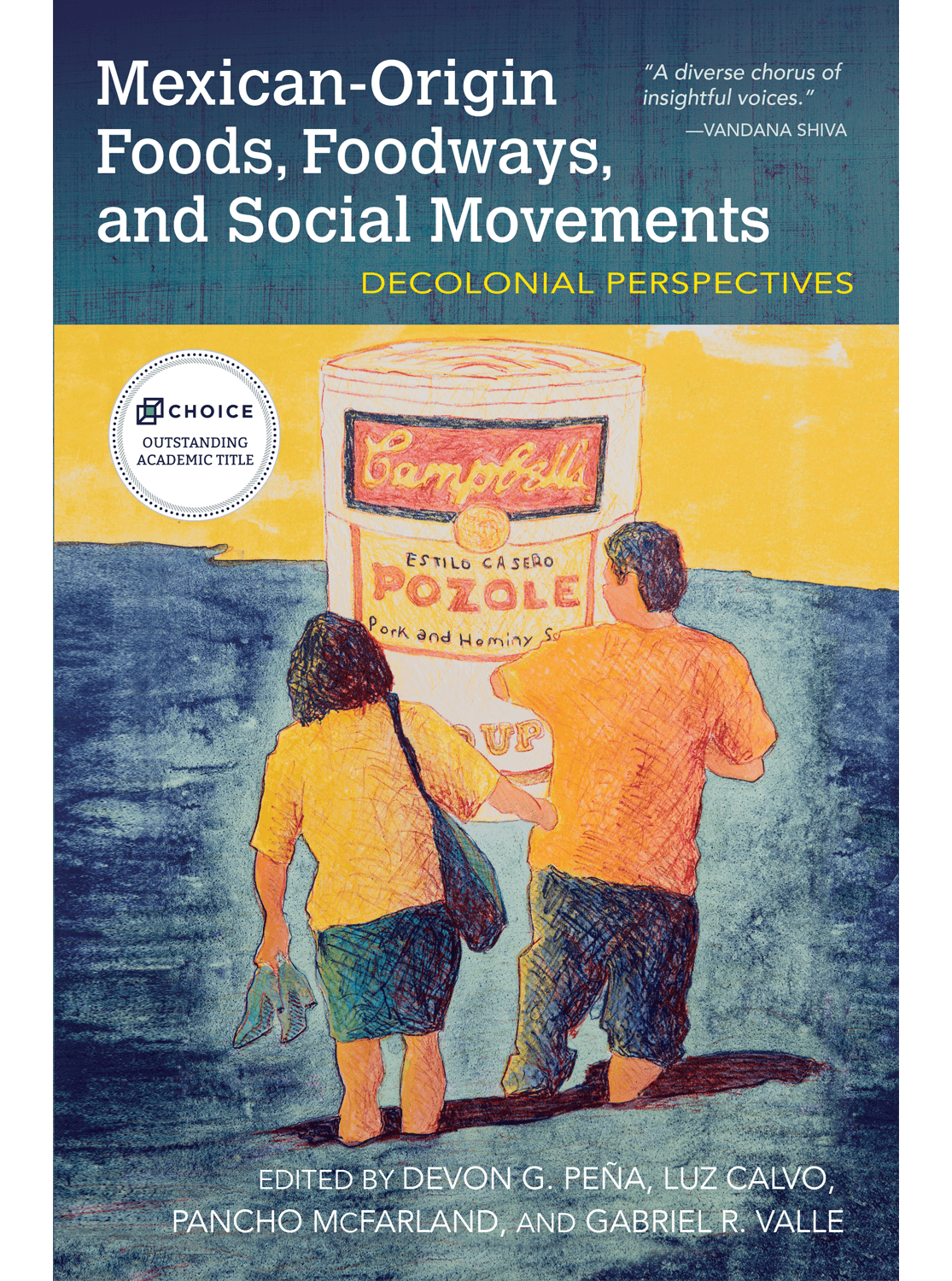
About A Choice Outstanding Academic Title This collection of new essays offers groundbreaking perspectives on the ways that food and foodways serve as an element of decolonization in Mexican-origin communities. The writers here take us from multigenerational acequia farmers, who trace their ancestry to Indigenous families in place well before the Oñate Entrada of 1598, to tomorrow’s transborder travelers who will be negotiating entry into the United States. Throughout, we witness the shifting mosaic of Mexican-origin foods and foodways in the fields, gardens, and kitchen tables from Chiapas to Alaska. Global food systems are also considered from a critical agroecological perspective, including the ways colonialism affects native biocultural diversity, ecosystem resilience, and equality across species, human groups, and generations. Mexican-Origin Foods, Foodways, and Social Movements is a major contribution to the understanding of the ways that Mexican-origin peoples have resisted and transformed food systems. It will animate scholarship on global food studies for years to come. Editors Devon G. Peña is a professor of American ethnic studies and anthropology at the University of Washington. Luz Calvo is a professor of ethnic studies at California State East Bay. Pancho McFarland is an associate professor of sociology at Chicago State University. Gabriel R. Valle is an assistant professor of environmental studies at California State University, San Marcos. Review “This edited volume breaks new ground in exploring decolonial movements connecting food to territory, subsistence, labor, local knowledge, memory, and identity. … The book serves as an outstanding model in methodology, combining narrative and life history, recipes, theory, and poetry and blurring ‘the lines between activism, scholarship, farming, cooking, and eating.'” Summing up: Essential. Upper-division undergraduates and above. —C.M. Kovic, Choice Reviews, August 2018 Praise “We live in a time when a handful of global corporations and philanthrocapitalists are pushing for a nonsustainable, unjust, unhealthy, and undemocratic model of ‘One Agriculture, One Science.’ This paradigm is based on GMO monocultures and patent monopolies on seed and knowledge. This volume offers a diverse chorus of insightful voices from farmers, cooks, seed savers, plant breeders, organizers, farm workers, and scholar activists. Together they are creating alterNative worlds. Mexican-Origin Foods, Foodways, and Social Movements shows many of the vital pathways to decolonizing and postcaptalist futures offered by the unity of biological and cultural diversity in shaping food as a vital source of cultural and ecological resilience, social and economic justice, and democratic values.” —Vandana Shiva Series Food and Foodways, a series from the University of Arkansas Press, explores historical and contemporary issues in global food studies. We are committed to telling lesser known food stories and to representing a diverse set of voices. Our strength is works in the humanities and social sciences that use food as a lens to examine broader, social, cultural, environmental, ethical, and economic issues. In addition to scholarly books, we publish creative nonfiction that explores the sensory dimensions of consumption and celebrates food as evidence of human creativity and innovation. Contents Introduction Mexican Deep Food: Bodies, the Land, Food, and Social Movements Devon G. Peña, Luz Calvo, Pancho McFarland, and Gabriel R. Valle Part I. Theorizing: Decolonial Food and Movements Poem From Borderlands/La Frontera Gloria Anzaldúa Chapter 1 Autonomía and Food Sovereignty: Decolonization across the Food Chain Devon G. Peña Chapter 2 Indigenous Women in the Food Sovereignty Movement: Lessons from the South Central Farm Rufina Juárez Chapter 3 Food Values: Urban Kitchen Gardens and Working- Class Subjectivity Gabriel R. Valle Chapter 4 Del alivio y coraje la tuna nacera: A Remembering of Land and Place Silvia Patricia Solís Part II. Witnessing: Heritage Cuisines and Decolonial Foodways Essay El Quelite Teresa Vigil Chapter 5 Tracing Food Packs and Tuna Cans on La Línea: Food, Water, and Foodways during Transborder Travel Consuelo Crow Chapter 6 Norteada/o en el barrio: Decolonizing Foodscapes in South Central Texas and Reclaiming Belonging Lee Ann Epstein Chapter 7 Tortilleras, testimonios, y recetas: Decolonial Foodways from the México- US Borderlands Luz Calvo and Catriona Rueda Esquibel Chapter 8 Chicos del horno: A Local, Slow, and Deep Food Joseph C. Gallegos Chapter 9 Travels of a Diaspora Community: From La Sierra Madre y Tierra Caliente to the Pacific Northwest María Guillen Valdovinos Chapter 10 Food, Class, Ethnicity, and Race in the Classroom: A Teacher’s Testimony Julia Curry Rodríguez Part III. Organizing: Decolonial Movements for Food Autonomy Poem “When Corn Silk Withers” Tezozomoc Chapter 11 Fragmentary Food Flows: Autonomy in the “Un-signified” Food Deserts of the Real Tezozomoc and the South Central Farmers Chapter 12 Growing Justice in the Fields: Farmworker Autonomy and Food Sovereignty Rosalinda Guillen and C2C Chapter 13 “We Are Human!”: Farmworker Organizing across the Food Chain in Washington Tomás Madrigal Chapter 14 Organic Intellectuals and Direct Action Fifty Years Past Chicago’s “War on Poverty” Pancho McFarland Chapter 15 Sin maíz, no hay país: Mesoamericans and Civil Society in the Defeat of Monsanto Adelita Sanvicente Tello and Araceli Carreón (Translated by Devon G. Peña) Chapter 16 Sodbusters and the “Native Gaze”: Soil Governmentality and Indigenous Knowledge Devon G. Peña Award Winner, 2018 ASFS (Association for the Study of Food and Society) Book Award, Edited Volume


 Mexican-Origin Foods, Foodways, and Social Movements